Why Is the Bay Delta So Important?

John Muir Land Trust Announces Campaign To Save Johnson Ranch
September 23, 2026
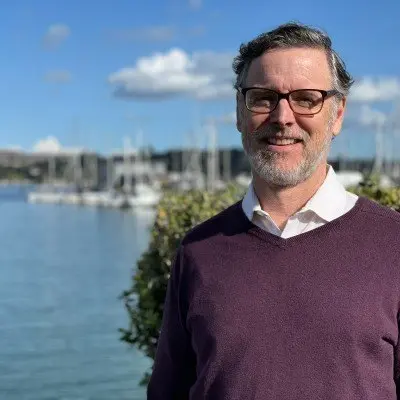
Campbell is Executive Officer of the Sacramento–San Joaquin Delta Conservancy, a primary state agency in the implementation of ecosystem restoration in the Delta.
The Delta by the numbers
- 27–30M people served by the Delta’s water supply
- 4M acres of San Joaquin Valley farmland depend on Delta water
- 20–25 ft that Delta land has sunk in places since it was drained for farming
- 1.2M tons of carbon dioxide a year from 150,000 sinking acres, about 375,000 cars’ worth
- 90–95% of the Delta’s original tidal habitat has been eliminated
Q: Campbell, why should Californians care about the Bay Delta?
That’s such a complex and long answer. The Delta is the confluence of the Sacramento and San Joaquin Rivers that drain most of the area of California. It serves as one of the major hubs of California’s water supply, serving between 27 and 30 million people in the East Bay, Los Angeles Basin, and along the Central Coast. It supplies water to about 4 million acres of agricultural land in the San Joaquin Valley. Some 90% of the precipitation that falls on California falls in the north, and yet 80% or 90% of the population and agriculture is in the south. It’s a critically important water supply hub; it’s where we transfer that water from one side to the other.
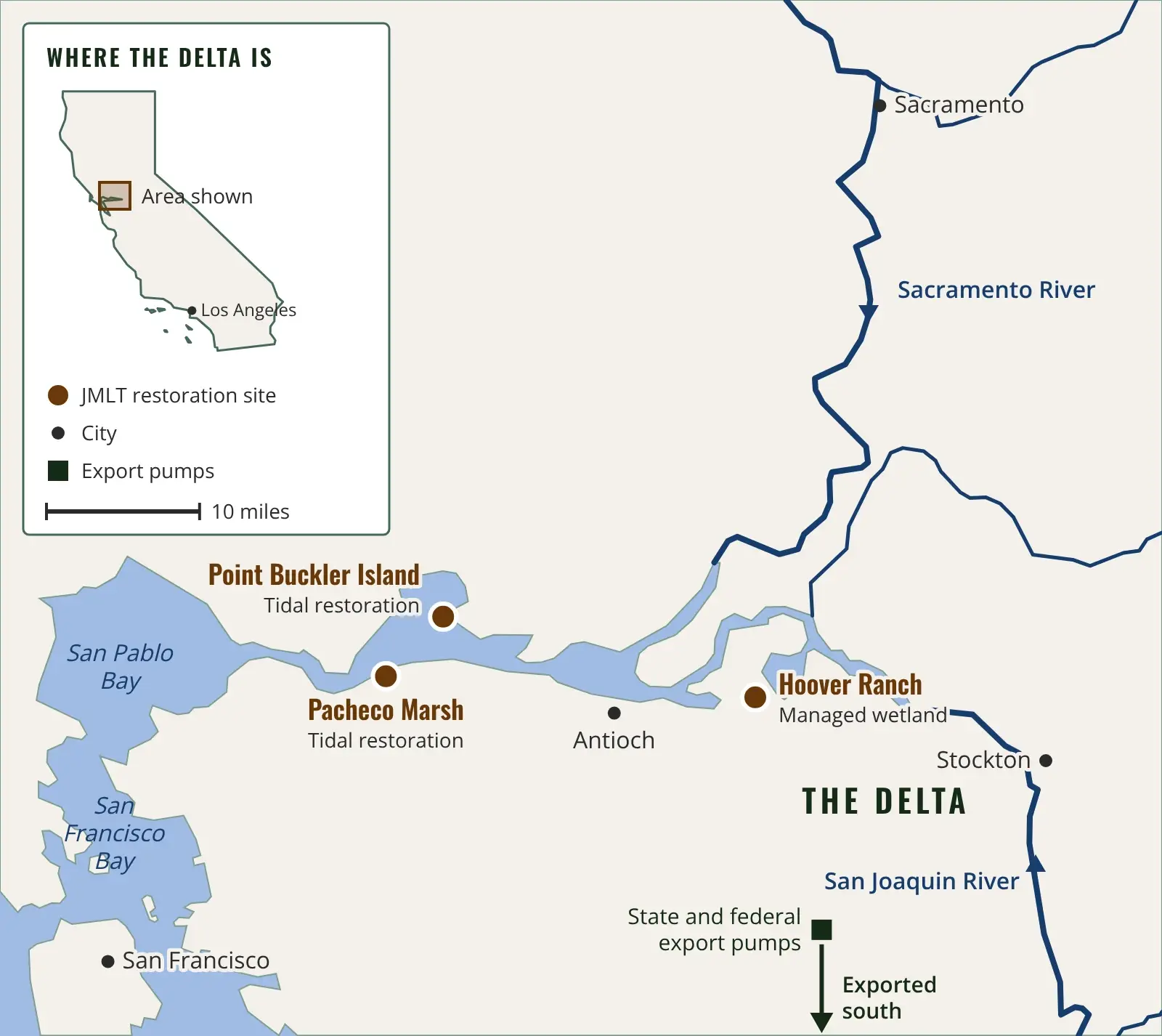
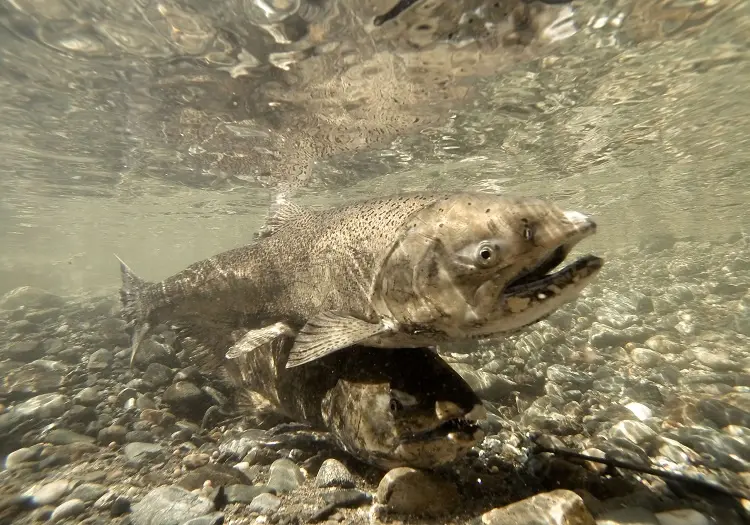
The Delta is critically threatened in many ways. Once complex wetland habitat, it has been reclaimed for agriculture, and that has fundamentally changed how water flows through it. The Delta no longer flows like aquatic wetland habitat producing food resource for wildlife; it’s now fast-moving channels that are isolated from the landscape. It has become a food desert, and that dramatically affects the salmon populations and other fish species that depend on it. Another important issue, from an ecological standpoint, is that when we export all that water out of the system, it creates reverse flows in the rivers that confuse salmon. Juvenile salmon imprint on local water qualities, and that’s what they use to navigate back to their natal stream. When salmon are swimming back up as adults to spawn, they miscue. Adults find Sacramento River water down in the South Delta, and they can head in that direction as opposed to heading up the Sacramento River itself. That causes delays in their spawning.
Q: Subsidence, or sinking of the land, is another issue we hear about. Could you explain that?
We reclaimed the Delta for agriculture starting back in the 1850s, and it’s an amazing agricultural region due to the highly organic peat soils that were deposited over 8,000 years. Over the centuries, as sea levels rose, the wetland kept pace and put down depths of 100 feet or more of peat. But when you drain peat soils for agriculture, they oxidize. Farmers must drain down 36 to 48 inches to aerate the root zone to grow corn and other crops. But that exposes the highly organic peat to microbes and oxygen, and when the microbes digest that carbon, their byproduct is carbon dioxide released directly into the atmosphere. Subsidence is caused by compaction and wind-blown loss, too, but that’s relatively small compared to oxidation. A part of the Delta, 150,000 acres in the center, continues to subside and produces 1.2 million tons of carbon dioxide per year, equivalent to about 375,000 vehicles. So that small area produces a significant portion of the total 8 million tons produced annually by 17 million acres of plant-based agriculture in California. It’s like a little chimney just pumping carbon into the atmosphere.
“It’s like a little chimney just pumping carbon into the atmosphere.”
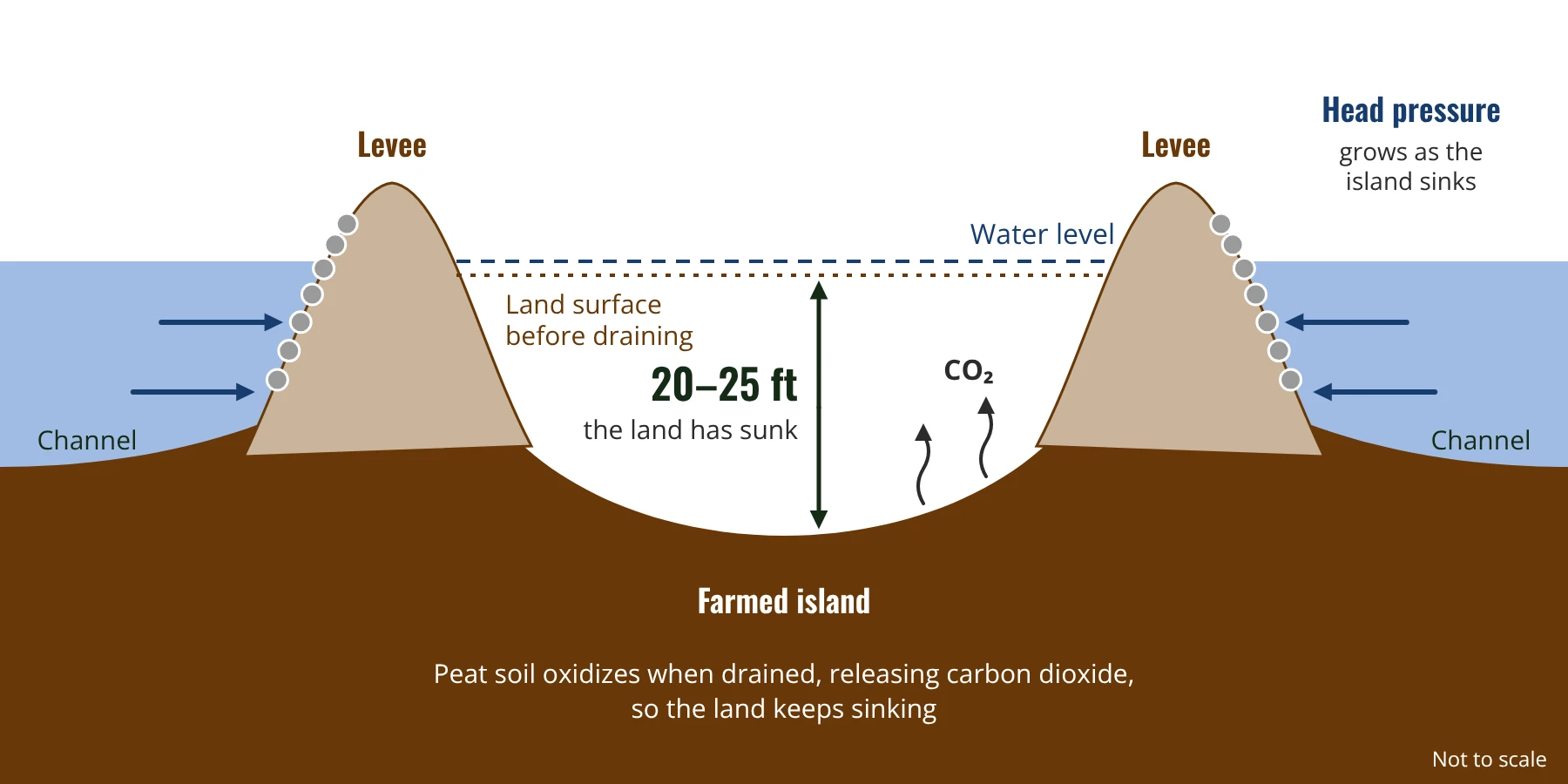
Subsidence threatens the whole system. The land has sunk by 20 to 25 feet. If we lose the levees from seismic activity or increased storm events, then water from somewhere has to fill that void. The closest source of water would be the Bay. We could lose the western Delta as it becomes an inland sea, likely saltwater, and that would create a long-term interruption in the water supply to those 27 million people and that 4 million acres of agricultural land. It could have significant economic and ecological impacts in California. The head pressure is ever increasing on these levees because oxidation and subsidence continue every year. There’s a fault zone there, but wind damage is more frequent. A really big storm could cause a levee collapse and the loss of one of these islands. If you lose one, then the wind energy pushes waves to erode another levee, and it becomes a domino effect. If salinity increases, there’s no way we’ll be exporting water out of the Delta.
Q: How do JMLT’s Bay Delta projects factor into this big picture?
The state has established a target of rewetting 50,000 acres of peat soil in the Delta by 2045. Basically, the way you stop oxidation is by putting water back on the landscape, by covering the peat with water. That is exactly what JMLT is doing with the 600 acres of former agricultural land at Hoover Ranch on Bethel Island. JMLT is putting water back and creating a managed wetland. That stops oxidation. If you manage water levels, you can start to accrete elevations very slowly and reduce head pressure on the levees.
You can utilize the carbon market to offset any lost agricultural value. There’s a carbon protocol that we supported and has been approved by the American Carbon Registry, and that allows JMLT to calculate the baseline emission that was coming off of that island before putting the water back and then calculate the amount of carbon sequestration that the wetland is achieving. A healthy wetland produces methane, so you must offset that, but if you have a third party do the verification you can certify those credits, and then take those credits to market.
How a rewetted wetland earns carbon credits
- Measure the baseline emissions coming off the drained land
- Put water back and manage it as a wetland
- Calculate carbon stored, offsetting the wetland’s methane
- A third party verifies, and certified credits go to market
Q: So, JMLT can potentially sell the carbon credits as a source of funding for our work?
Exactly. You can stop the subsidence, you can start to accrete a little bit of elevation, which helps to reduce the pressure on the levees, and you can improve biodiversity because birds and amphibians and other wildlife will utilize these wetlands. There’s also interest in engaging with tribes, such as having tribes come in and help do long-term management like cultural burning.
Q: How do the JMLT tidal restoration projects at Pacheco Marsh and Point Buckler fit in?
Hoover Ranch is 20 feet below sea level. You cannot reconnect the tidal processes at Hoover, otherwise you would just turn the whole island into a 20-foot-deep lake. Point Buckler and Pacheco Marsh are excellent examples of recreating tidal habitat, and that gets back to the original question. The whole Delta was once all tidal habitat, and tidal habitat is among the most biodiverse and richest ecosystems on Earth — the basis of the food chain. We’ve eliminated 90% to 95% of the tidal habitat that once covered the Delta. Projects that recreate tidal process are extremely important.
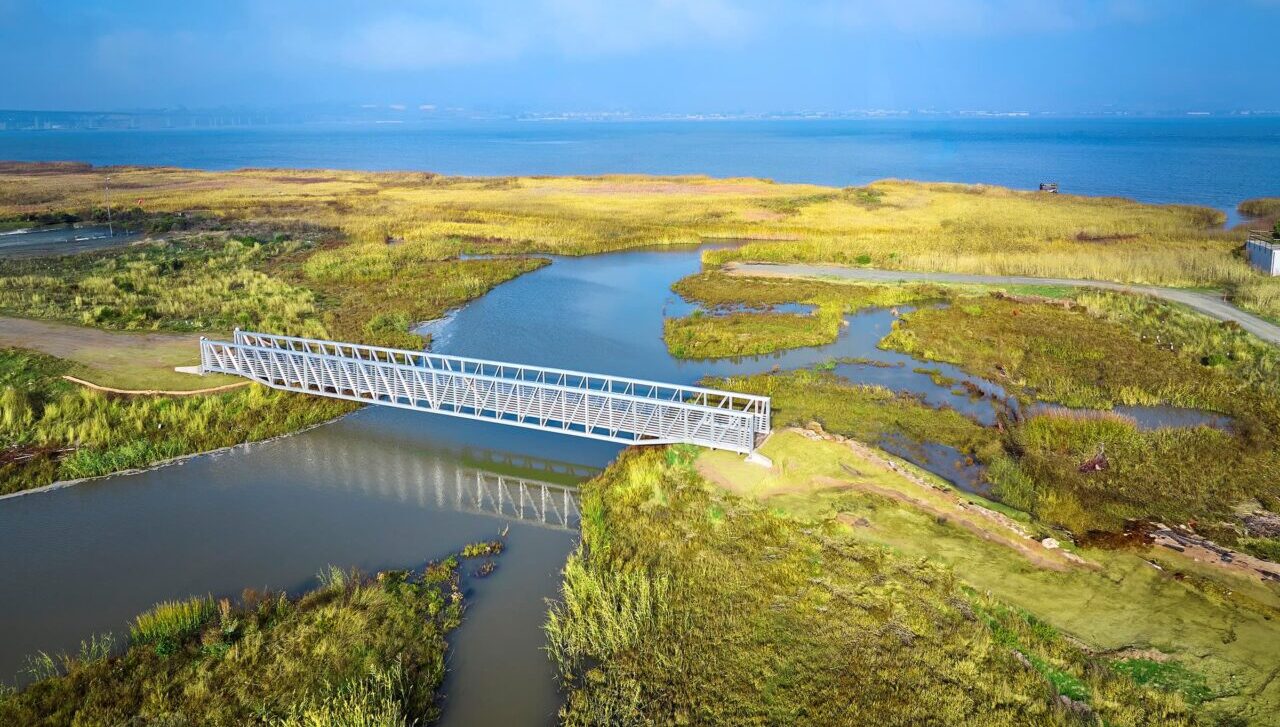
When juvenile salmon start migrating down the Sacramento River and they get to about Sacramento, it literally becomes a food desert. It is just fast-moving water not connected to wetland habitat. There’s no primary production. There’s no phytoplankton, no zooplankton being pumped into the system. The fish are tiny and they literally have to go 70 or 80 miles out to the estuary before they get to a place that’s food-rich again. It was once very complex wetland. Now that water just zips straight through deep fast-moving channels that don’t really have any food resource in them. That’s why we need tidal habitat restoration.
“The fish are tiny and they literally have to go 70 or 80 miles out to the estuary before they get to a place that’s food-rich again.”
Q: So it’s imperative to reverse that if we want the salmon to survive long term?
Yes. Salmon populations are gradually declining. It’s a combination of things. Every significant drought, populations get a little bit lower. There’s not enough water in the system. There’s not enough food in the system. The habitat has been removed. All these things are gradually causing population numbers to decrease. We must recreate tidal habitat. We must recreate more natural flows in the system.
Q: JMLT supporters generously donate money to fund these projects. What else can people do to help?
These projects cost a lot of money. That’s the biggest issue. We need to fundamentally de-risk California’s water supply, and yet we’re not funding it. The Climate Bond, Proposition 4, passed a while ago but we received only $29 million out of a $10 billion bond to address this problem. There’s a huge disconnect between the significance of the problem and funding levels to address it.
$29 million of a $10 billion bond
The Delta’s share of the Proposition 4 Climate Bond was less than one-third of one percent. The thin brown line above is drawn to scale.
Even in Southern California there’s a lack of understanding that their water supply depends on the Delta, that investments need to be made in the Delta to preserve water and the economy of California. We did get a one-time $37 million General Fund boost a couple of years ago, and that helped buy Hoover Ranch, but that money is pretty much dried up. People can vote. People can help get the message out about how significant the Delta is and what needs to be done to address these issues.
Think of it this way: we talked about 27 million people, 4 million acres of arable land, a major potential interruption of water supply. That affects the economy. A major interruption would have a drastic impact in California, the fourth or fifth largest economy in the world. The Bay Delta affects all of us.
“The Bay Delta affects all of us.”